
How to Stake on Binance: 2026 Complete Guide
How to stake on Binance in 2026: Simple Earn Locked (4-8% APY), Flexible (0.5-5%), BNB Vault (~18% APR), SOL Staking (BNSOL liquid), and Yield Arena pools.
How do you stake on Binance? Sign in to Binance, tap Earn in the bottom navigation, choose a staking surface (Simple Earn Locked, Simple Earn Flexible, BNB Vault, SOL Staking, or Yield Arena), pick the asset and amount, then confirm. The mechanic is genuinely simple. The context every user needs before tapping Earn is not: staking and lending are blocked for residents of the United Kingdom, Canada, Australia, and Japan on binance.com; United States residents are routed to Binance.US, a separate product with basic staking limited to ETH and SOL and several state-level blocks. European Union residents are on a regulatory bet through Binance's January 2026 MiCA licence filing via its Greek subsidiary "Binary Greece" ahead of the 1 July 2026 deadline.
This guide answers what a working Binance user actually needs about how to stake on Binance in 2026: which staking surfaces exist and how they differ, realistic APY ranges per surface, the procedural steps to subscribe, how rewards are valued for tax reporting, the slashing-coverage policy that justifies the APY haircut versus running your own validator, the regional access map, and how Binance staking compares to Coinbase, Kraken, and liquid staking protocols like Lido and Rocket Pool. Every figure is sourced to a primary citation in the footer.
Can you stake on Binance in your country in 2026?
The first thing to know about how to stake on Binance is that it depends on where you live, and the in-app flow does not tell you in advance. The binance staking countries map is fragmented along the regulatory lines national regulators drew between 2023 and 2025. Staking and lending are blocked for residents of the United Kingdom, Canada, Australia, and Japan on binance.com; the platform suspended these services in response to regulatory pressure from the Financial Conduct Authority, the Canadian Securities Administrators, the Australian Securities and Investments Commission, and the Japan Financial Services Agency respectively. United States residents cannot use binance.com at all and are routed to Binance.US, which carries a separate licence and a narrower product menu. Iran, Cuba, Syria, and North Korea are blocked under United States Office of Foreign Assets Control sanctions.
| Jurisdiction | Staking access on binance.com | Alternative |
|---|---|---|
| European Union | Active, conditional on MiCA outcome | Same product through the Greek-subsidiary filing |
| United Kingdom | Blocked | Coinbase, Kraken UK, or self-custody |
| United States | Blocked | Binance.US (ETH + SOL only), Coinbase, Kraken |
| Canada | Blocked | Coinbase Canada, Kraken Canada, or self-custody |
| Australia | Blocked | Independent Reserve, Coinjar, or self-custody |
| Japan | Blocked | bitFlyer, Coincheck, or self-custody |
| Singapore | Active | Standard staking products |
| Hong Kong | Active for retail users on licensed venues | HashKey is the local-licensed alternative |
| Iran, Cuba, Syria, North Korea | Blocked (OFAC sanctions) | None compliant |
Binance.US, the United States subsidiary, is fully unavailable to residents of Alaska, American Samoa, Hawaii, Maine, New York, the Northern Mariana Islands, Texas, the United States Virgin Islands, and Vermont. New registrations are paused in Connecticut, Florida, Georgia, Guam, Minnesota, North Carolina, Ohio, Oregon, and Washington. Staking on Binance.US is limited to Ethereum and Solana.
European Union staking access depends on the Markets in Crypto-Assets regulation. Binance applied for a pan-European Union MiCA licence through its newly established Greek subsidiary "Binary Greece" in January 2026, positioning the company for full compliance before the 1 July 2026 deadline; the MiCA regulation text is published by ESMA. The outcome of that application is unknown at the time of writing and will determine whether Binance staking remains available across the 27 European Union member states through the second half of 2026.
What are the five Binance staking products in 2026?
Binance bundles five distinct staking surfaces under the Earn section of the app. They look similar from the home screen but pay yield from different sources and carry different risk profiles. Picking the highest headline APY without understanding what is paying it is the most common mistake new stakers make on the platform.
| Product | Lockup | Typical 2026 APY range | Reward cadence | Notes |
|---|---|---|---|---|
| Simple Earn Locked | 7 to 120 days | 4% to 8% on major PoS assets | Daily distribution | Early redemption forfeits all accrued interest |
| Simple Earn Flexible | None | 0.5% to 5% | Real-time APR added every minute; Bonus Tiered APR daily | Two reward streams; redeem any time |
| BNB Vault | None (subscription required) | ~12% to 18% APR observed snapshot | Continuous via Vault rebalancing | BNB-specific; routes funds across Launchpool, DeFi Staking, and Simple Earn Flexible |
| SOL Staking (BNSOL) | None (liquid) | ~6% to 8% network APY | Per Solana epoch (2 to 3 days) via ratio | Receive BNSOL liquid staking token; tradeable while earning |
| Yield Arena | Variable (often locked) | Campaign-specific, can exceed 30% short-term | Campaign terms (daily to weekly) | Promotional reward pools; limited subscription slots |
The APY values above are observations from early 2026 and are not guarantees. Binance documents publicly that "Locked Product APR is subject to change on a daily basis" and that the platform "does not guarantee that users will receive any staking return or specific staking reward over time." Treat every quoted range as a snapshot.
How to stake on Simple Earn Locked Products
Simple Earn Locked is the closest analogue to traditional staking on a centralized exchange. You commit a fixed amount of a specific cryptocurrency for a fixed term (typically 7, 14, 30, 60, 90, or 120 days), and Binance pays a fixed APR for the duration. Longer locks generally pay higher APR. Coins must be in your Spot wallet before they can be subscribed; the Funding wallet and Margin wallet do not stake.
To begin, open the Binance app and sign in. From the home screen, tap Earn in the bottom navigation, or tap More and scroll to Simple Earn.
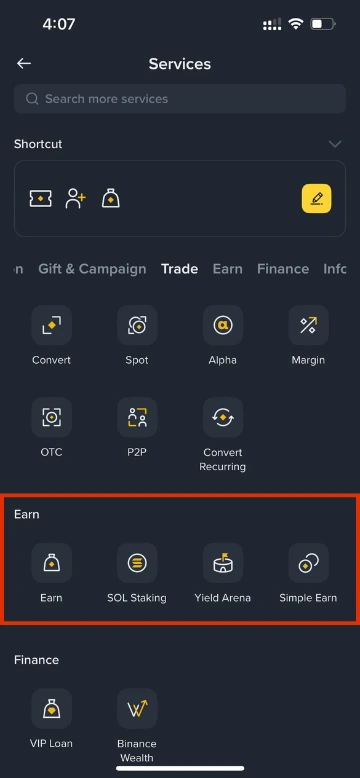
You will see two product surfaces inside Simple Earn: Locked Products and Flexible Products. For a fixed-term version of how to stake on Binance, tap Locked Products; product mechanics are documented at binance.com/en/earn/simple-earn and the Flexible Products onboarding FAQ at binance.com/en/support/faq.
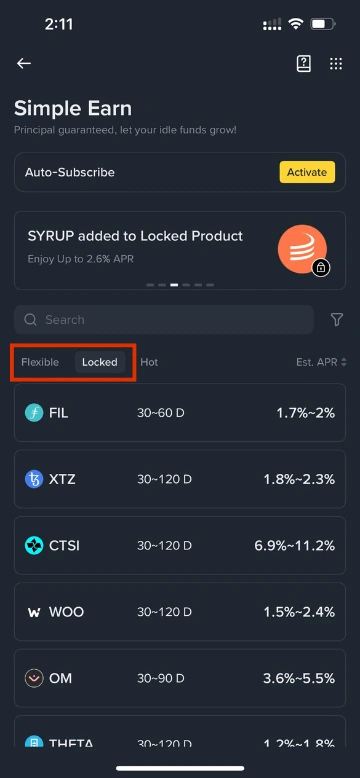
The Locked Products screen lists available cryptocurrencies with their annual percentage yield, minimum staking amount, lockup periods, and current subscription status. APY varies by asset and by lockup duration. Popular coins frequently have limited subscription slots; if a particular asset's slot is fully subscribed, you can wait for the next subscription window or pick a shorter or longer lockup.
Tap the asset you want to stake. The subscription screen asks for the lockup period (longer durations usually pay higher APY) and the amount of crypto to subscribe. Each asset has specific minimum and maximum staking limits displayed on the page. Confirm the entry to see the staking summary.
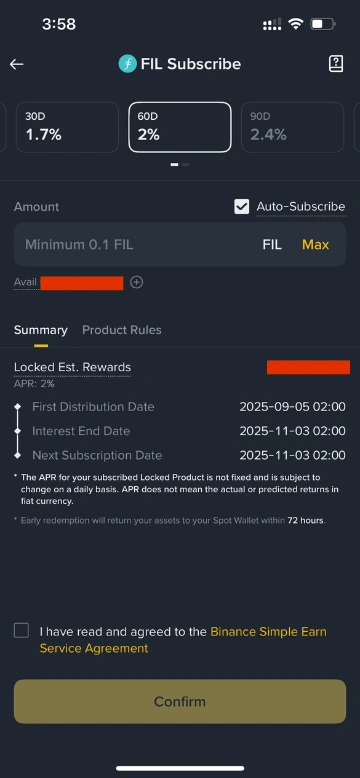
The staking summary shows three dates: stake date (today), value date (the day after subscription, when rewards begin accruing), and redemption date (the day the lockup ends). Coins must remain locked for the entire period to earn the full interest amount. Rewards are distributed daily to your Spot wallet, not added back to the locked principal.
Early redemption is possible but the penalty is total: you forfeit all accrued interest plus a 2-to-3-day processing delay before the principal returns to your Spot wallet. To redeem early, navigate to Wallet, then Earn, then Simple Earn, then Locked; find your position and tap Redeem. The app shows a warning about interest forfeiture before confirmation.
How does Simple Earn Flexible compare?
Simple Earn Flexible removes the lockup. You subscribe to an asset, earn yield while you hold it inside Flexible, and redeem any time without penalty. The trade-off is a lower headline APY and a two-tier reward structure that rewards larger balances more heavily.
Access Flexible Products through the same Earn section. Tap Flexible to see the available assets with their current APR.
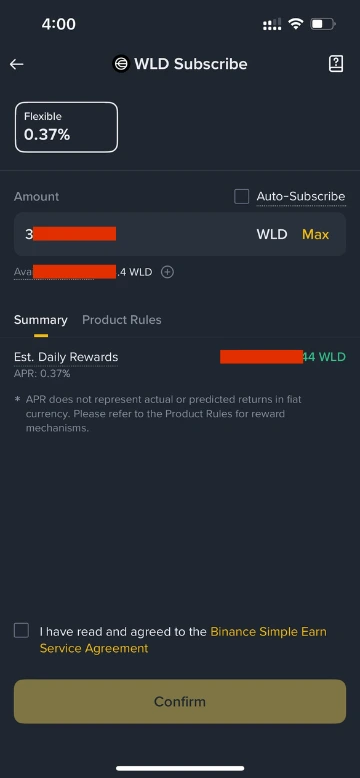
Flexible products pay two reward streams. The first is Real-Time APR, added to your Flexible balance every minute and visible in the Wallet view. The second is Bonus Tiered APR, distributed once daily to your Spot wallet. The Tiered APR only applies above a per-asset threshold that Binance publishes in the product details; smaller balances receive the Real-Time APR alone.
Flexible is the right choice when your hold horizon is uncertain or short. Locked is the right choice when you have a committed 30-day-plus horizon and want the higher APY. The break-even between the two depends on the specific asset and the lockup term; for major proof-of-stake assets like BNB, ETH, and SOL, the Locked premium over Flexible is typically 100 to 300 basis points.
How does the BNB Vault work?
BNB Vault is a BNB-specific product that automatically rebalances a user's deposited BNB across three underlying surfaces: Binance Launchpool (where BNB earns newly listed tokens distributed by partner projects), DeFi Staking (where BNB is routed to BNB Chain DeFi yield positions), and Simple Earn Flexible (the standard lending-side flow). The Vault adjusts allocations dynamically to optimize APR.
The Vault stood at 18.04% APR at one observed snapshot in early 2026, considerably above standard Simple Earn Flexible BNB rates. Binance documents publicly that BNB Vault APR is subject to change on a daily basis and includes Launchpool airdrop returns, which inflate during active campaigns and compress when the Launchpool pipeline is quiet.
Two risk caveats matter for BNB Vault. First, the DeFi Staking component routes funds through BNB Chain DeFi protocols with smart-contract and impermanent-loss risk that does not exist in pure Simple Earn. Second, BNB staked on the platform that issues BNB is concentrated single-issuer exposure: a major Binance operational event would compound with a BNB price event in a correlated way. For BNB holders with a long horizon and tolerance for the issuer-platform correlation, BNB Vault is the highest-yield route in the Binance staking menu; for users uncomfortable with that correlation, Simple Earn Flexible or Locked is the more conservative route.
How does Binance SOL Staking and BNSOL work?
SOL Staking on Binance is a liquid-staking product. When you subscribe, you deposit SOL and receive BNSOL (Binance Staked SOL) in return. BNSOL is a transferable, tradeable token that represents your staked SOL plus accumulated staking rewards. The product earns network-level Solana staking APY, typically 6% to 8%, passed through to BNSOL holders via the BNSOL:SOL conversion ratio.
From the home screen, tap More, scroll to the Earn section, and tap SOL Staking.
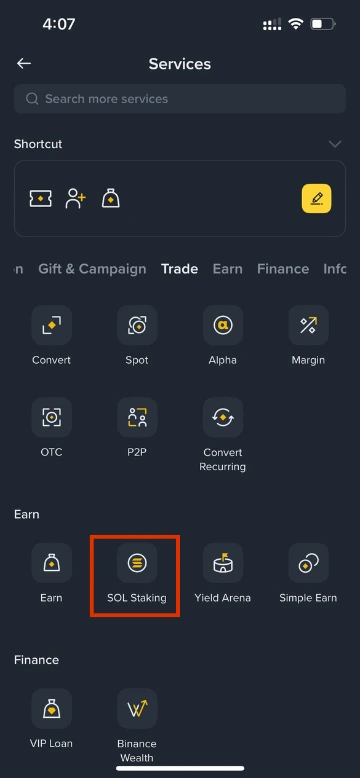
Enter the amount of SOL you want to stake. The subscription screen displays the minimum stake amount and the current BNSOL:SOL conversion ratio. The ratio is greater than 1 because each BNSOL represents 1 SOL plus all staking rewards earned since the BNSOL program began. The ratio updates approximately every 2 to 3 days, following each Solana epoch.
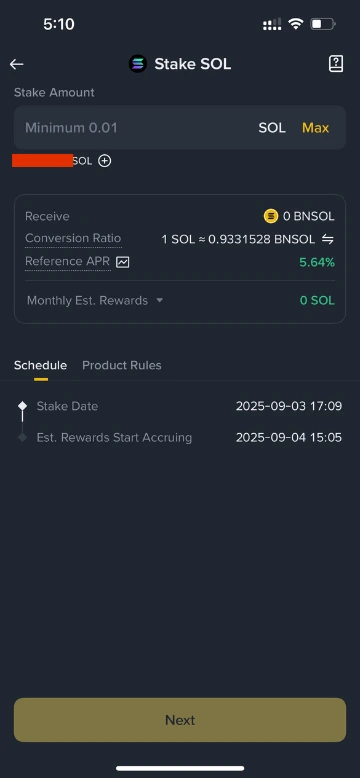
The mechanical advantage of BNSOL is liquidity. Unlike Locked staking, you can trade, transfer, or use BNSOL in other applications while it continues to earn staking rewards. The mechanical caveat: if you sell or transfer BNSOL, the new holder receives all future staking rewards. To redeem your original SOL plus earned rewards, convert BNSOL back to SOL at the current ratio. Binance bears the validator slashing risk on the underlying SOL, so BNSOL holders are not directly exposed to slashing forfeiture.
What is Binance Yield Arena?
Yield Arena is Binance's campaign hub for promotional staking offers. From the home screen, tap More, scroll to Earn, then tap Yield Arena.
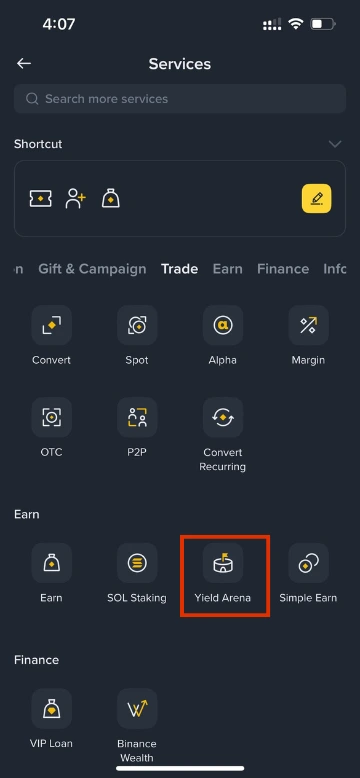
Yield Arena features rotating campaigns with enhanced APRs, dedicated reward pools, and limited subscription slots. Campaigns cover BNB, BB (BounceBit), SOLV, and other tokens, with reward pools ranging from hundreds of thousands of dollars to over one million dollars per campaign.
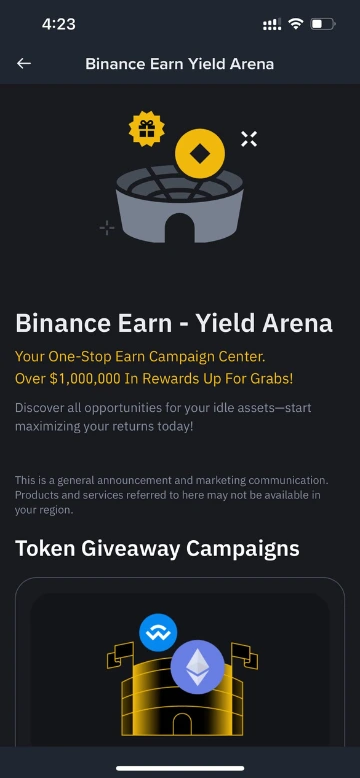
Each campaign listing shows the enhanced APR, the reward pool size, and the subscription period. Some campaigns offer Flexible terms with continuous accrual; others require Locked subscription for the campaign duration. Popular campaigns sell out quickly because reward pools are capped.
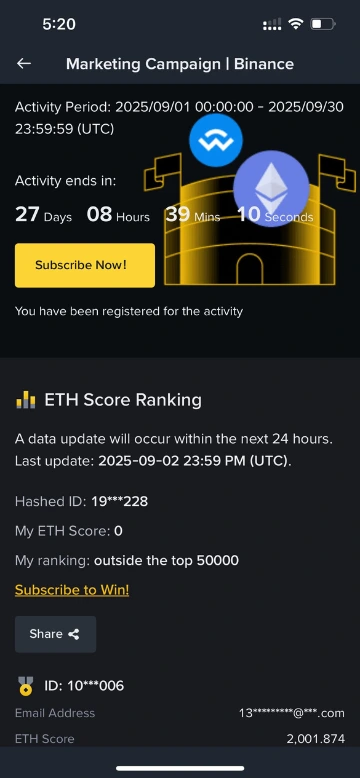
The honest framing of Yield Arena: campaign APR is real but the reward pool is fixed. If subscription demand exceeds the pool capacity, individual user rewards dilute proportionally. The high headline APR you see at the start of a campaign is a function of low total subscriptions; as the campaign fills, the realized APR falls toward the documented floor. Read the campaign-specific terms before subscribing, the variable that matters most is the total pool size relative to the headline APR.
How do staking rewards get valued for tax reporting?
Staking rewards are typically taxable as income at fair market value in your tax-jurisdiction currency on the day they are received. The exact tax treatment varies by country, but the recordkeeping requirement is consistent: every reward event needs a date, an asset, a quantity, and a fair-market-value record in your reporting currency at the moment of receipt.
For Locked products, daily reward distribution makes daily fair-market-value recording practical. For Flexible products, the Real-Time APR adds rewards every minute, but most tax software aggregates these into daily totals. BNSOL is trickier: the rewards accrue through the BNSOL:SOL ratio update rather than as discrete distributions, which creates ambiguous timing in some jurisdictions. Tax authorities in the United States, the United Kingdom, and Australia have not all converged on whether liquid-staking-token ratio appreciation is a constructive receipt event or a deferred-disposition event.
Skrumble note on price aggregation: Skrumble's price data pulls from multiple venues per asset rather than relying on a single exchange snapshot. When a staking reward arrives in the middle of an exchange outage or a localized price dislocation, the multi-venue aggregate is the figure that survives audit. Most portfolio trackers pull from one exchange feed; cross-source aggregation is what we use internally for our reviews and would recommend you replicate (or reference our published rates) when recording high-value income events.
Portfolio trackers like Koinly, Kryptos, and CoinLedger connect to Binance via API and pull both trade history and staking reward events. They export tax reports formatted for the major filing regimes, including United States Form 1099-DA, United Kingdom Self Assessment, Singapore IRAS, Canada CRA, and Australia ATO. For Singapore-specific tax treatment of staking rewards, see our Singapore crypto tax guide; for Canadian users, our Canada crypto bank guide covers the institutional context.
What are the real risks of staking on Binance?
Staking on Binance reduces some risks that exist on smaller exchanges and self-custody validators, and introduces others that do not exist anywhere else. The honest risk inventory is the only frame that lets a new user decide whether the APY is worth it.
- Lock-up forfeiture on early redemption. Locked products forfeit all accrued interest plus a 2-to-3-day processing delay if redeemed before maturity. The penalty is total, not pro-rated.
- Slashing-coverage policy, not contract. Binance documents publicly that it absorbs slashing on most staked assets as a platform policy, which justifies the APY haircut versus running your own validator. The platform also documents that it does not guarantee any specific staking reward and reserves the right not to reimburse. The coverage is a policy, not a contractual right.
- Platform counterparty risk. Full operational and custody risk on the exchange itself. Binance has had several years of regulatory headwind, including the CZ-era Bank Secrecy Act guilty plea in November 2023, the four-month custodial sentence CZ served, and the October 2025 presidential pardon. The platform now operates under a Teng plus Yi He co-CEO structure (Yi He appointed November 2025) that is different from the founder-led structure most legacy reviews describe.
- DeFi exposure inside BNB Vault. The Vault routes a portion of deposited BNB through BNB Chain DeFi protocols with smart-contract risk and impermanent-loss risk that does not exist in pure Simple Earn. Users selecting BNB Vault for the higher headline APR should treat the DeFi component as part of the risk premium.
- Regional access can change without notice. The blocks against the United Kingdom, Canada, Australia, and Japan are the precedent. The European Union access is currently conditional on the January 2026 Greek-subsidiary MiCA filing succeeding before the 1 July 2026 deadline.
- Concentrated-issuer risk on BNB. Staking BNB on the platform that issues BNB compounds the issuer event and platform event into a single risk position.
- APY changes daily. Every quoted range in this guide is a snapshot from early 2026 observation. Binance publishes the daily-change disclaimer in every product page.
How does Binance staking compare to Coinbase, Kraken, and liquid staking protocols?
Binance staking competes on breadth (over 100 assets supported, more product surfaces) rather than on maximum APY on any single asset. For ETH specifically, Lido and Rocket Pool typically pay higher network APY because there is no exchange take. For SOL, native Solana validators pay closer to the protocol APY than the Binance-mediated rate. The trade-off is custody and complexity.
Coinbase stakes ETH, SOL, ADA, MATIC, and a handful of other proof-of-stake assets through a regulated United States product (coinbase.com/staking). The APY is typically 50 to 200 basis points below Binance because Coinbase takes a larger commission, and the available menu is smaller. State-level coverage in the United States is better than Binance.US for most users. The honest framing is that Coinbase is a higher-trust, lower-yield staking venue.
Kraken restored Ethereum staking for United States users after settling its September 2023 SEC enforcement action; non-United States users had continuous access throughout. Kraken's APY is competitive with Binance on the assets it supports, the regulatory licence stack is named (FinCEN MSB, FCA EMI, JFSA), and the product menu is narrower. For United States users specifically, Kraken's staking menu is a cleaner alternative to Binance.US.
Liquid staking protocols (Lido, Rocket Pool, Frax Ether) provide non-custodial staking via smart contract. They pay closer to the protocol APY because there is no centralized take, and they issue a liquid staking token (stETH, rETH, frxETH) that retains tradeability. The trade-off is full smart-contract risk and the operational burden of managing the staking position on-chain. For users comfortable with self-custody and on-chain operation, liquid staking pays the highest realized APY on Ethereum; for users who prefer a custodial exchange experience, Binance, Coinbase, and Kraken cover the same use case at a yield discount.
Frequently asked questions
Auto-rendered from the data contract.
Frequently asked questions
How do you stake on Binance in 2026?
What is the difference between Simple Earn Locked and Flexible?
What is the BNB Vault APY?
How does Binance SOL Staking and BNSOL work?
Which countries cannot stake on Binance?
Is BNB staking safe on Binance?
Does Binance charge a fee for staking?
How are Binance staking rewards taxed?
Sources
- [1]Binance: Earn — Simple Earn product page — Binance · accessed
- [2]Binance: Get Started with Simple Earn Flexible Products (Support FAQ) — Binance · accessed
- [3]Binance.US: Supported and Unsupported States and Regions — Binance.US · accessed
- [4]Fortune: Binance applies to Greek regulators for MiCA license — Fortune · published · accessed
- [5]Fortune: Trump pardons Binance founder Changpeng Zhao — Fortune · published · accessed
- [6]The Block: Binance appoints Yi He as co-CEO alongside Richard Teng — The Block · published · accessed
- [7]ESMA: Crypto-Assets Policy and MiCA Regulation — European Securities and Markets Authority · accessed
More in Staking & passive yield
What is Staking? 2026 Crypto Staking Complete Guide
What is staking? Three types (native, liquid, restaking), realistic 2026 APYs (ETH 2.84%, SOL 5-6%, ADA 3.5%), $245B global market, slashing risk explained.
What is Restaking? 2026 EigenLayer + LRT Guide + Risks
What is restaking in 2026: EigenLayer at $18B restaked ETH, LRTs led by Ether.fi at $5.6B, AVS slashing, post Kelp DAO exploit risk reset, and yield math.
How to Stake Ethereum: 2026 Complete Guide
How to stake Ethereum in 2026: native solo (32 ETH, ~4% APR), Lido liquid (3.2%), Rocket Pool (3.46%, 8-16 ETH), CEX (2-2.84%), plus EigenLayer restaking.
How to Stake Solana (SOL) in 2026: Native + jitoSOL Guide
How to stake Solana in 2026: native delegation at 5-7% APY, jitoSOL liquid staking with MEV, one-epoch unstake cool-down, validator selection, and US taxes.